
Tough deposits do not all respond to the same water pressure, nozzle, or cleaning sequence. By identifying the deposit, calculating the energy reaching the surface, checking equipment limits, and comparing wastewater and outage costs, you can decide when hydro jetting is the right removal method and when another treatment is safer or faster.
Key takeaways
- Specify both nozzle pressure and water flow; pressure alone does not define jetting performance.
- Match nozzle design and jet force to the deposit, passage size, and equipment material.
- Confirm pressure ratings, reaction-force controls, isolation, and wastewater containment before starting.
- Inspect for remaining scale, erosion, corrosion, and damage after hydro jetting.
What Hydro Jetting Means—and What the Pressure Number Leaves Out
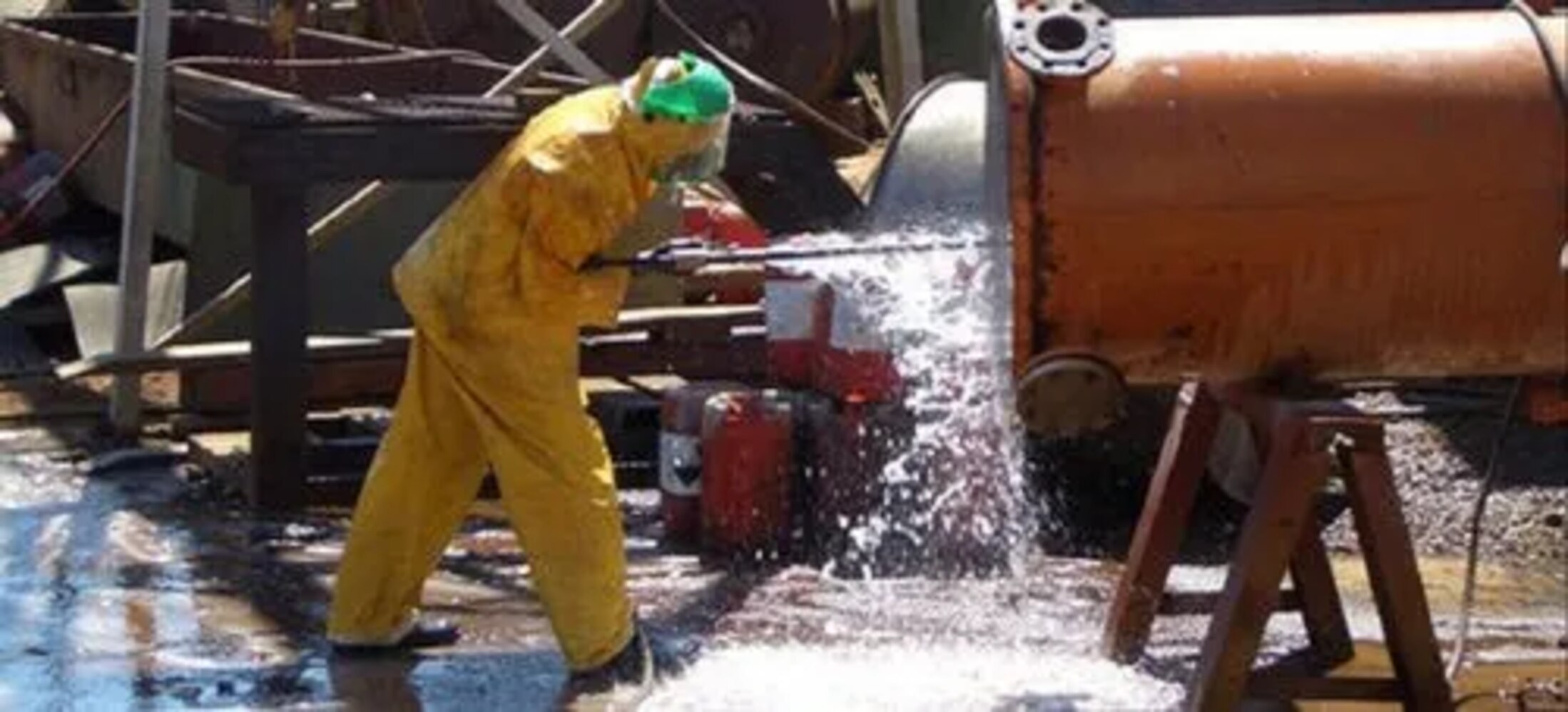
Hydro jetting removes deposits by converting pressurised water into a focused mechanical force. High-pressure water jetting usually means about 5,000–30,000 psi; ultrahigh-pressure jetting exceeds about 30,000 psi. Hydroblasting and water blasting are broader trade terms, not fixed pressure classes, so your scope must state nozzle pressure and flow.
Low-pressure washing operates below that range and suits loose dirt, salts, and rinsing—not hard scale.
| Method | Pressure description | Typical use | What the label leaves out |
|---|---|---|---|
| Low-pressure washing | Below high-pressure water jetting range | Loose soil, rinsing, light fouling | Flow, detergent, and contact time determine results |
| High-pressure water jetting | About 5,000–30,000 psi | Scale removal, tube cleaning, surface preparation | Nozzle design, distance, angle, and flow |
| Hydroblasting or water blasting | Umbrella terms; pressure varies | Industrial cleaning under a written work scope | The term alone gives no usable cleaning specification |
| Hydro jetting | Commonly used for pressurised water cleaning | Internal passages, heat exchangers, vessels, and surfaces | Delivered pressure can fall through hoses, lances, and fittings |
Judge cleaning power by delivered hydraulic power, not pressure alone. Use hydraulic horsepower = pressure (psi) × flow (gpm) ÷ 1,714; litres per minute matters because higher flow improves flushing and productivity. Also check nozzle impact, standoff distance, spray angle, and whether the jet can carry loosened debris away.
A high-pressure, low-flow jet can punch hard without clearing the passage.
Match the Jetting Method to the Deposit and the Passage
Identify the deposit from a dry scraping, a settled sample, and a controlled spot test before selecting a nozzle or chemical. A narrow tube with hard, continuous scale needs a different decision from an open vessel coated with soft sludge.
| Deposit | Signs in the sample | First-choice route |
|---|---|---|
| calcium carbonate scale | White or cream, chalky, hard; fizzes with dilute acid | Mechanical jetting on accessible surfaces; chemical descaling for thick tube deposits |
| silica scale | Grey-white, glassy, and resistant to dilute acid | Abrasive or high-energy mechanical action; specialist chemical treatment may follow |
| iron oxide | Red-brown or black powder, flakes, or hard nodules | Jetting with containment; investigate corrosion before chemical cleaning |
| biofilm | Slimy, odorous, gelatinous layer with biological growth | Biofilm removal by controlled jetting plus an approved biocide where required |
| sludge | Soft, wet, layered solids that smear or settle | Vacuum recovery, flushing, or low-pressure jetting before higher-energy cleaning |
| polymer residue | Sticky, rubbery, or heat-softened film | Solvent-compatible treatment or mechanical removal; water alone can spread it |
| coke | Black, dry, brittle, carbon-rich crust | High-energy mechanical cleaning or a process-specific solvent |
| mixed deposits | Distinct layers, such as oil over scale or rust under biofilm | Separate the layers and sequence methods rather than using one setting |
Passage geometry decides the tool. Rigid lances suit straight, accessible runs; flexible or self-propelled tools suit bends, but hard internal scale in a small diameter can make chemical descaling faster. Collect and characterize spent water before disposal because metals, oil, biocides, and process chemicals can turn wash water into regulated waste.
Check Equipment Limits Before Water Reaches the Surface
A pump setting is not permission to jet. Before water reaches the surface, obtain the equipment drawing, material data, wall-thickness records, and manufacturer limits; a nozzle that removes brittle scale can erode thin metal, lift a coating, or expose a hidden defect.
1. Confirm tube access: internal diameter, length, bends, tube-sheet layout, plugged tubes, and entry clearance. Record the tube material and wall thickness, then select a rigid lance, flexible lance, self-propelled nozzle, or rotary tool that will not lodge or reverse into the tube.
2. Verify plate thickness and the allowable pressure, flow, standoff distance, and dwell time for each plate. A thin plate or locally thinned area needs lower impact energy and faster movement than sound heavy plate.
3. Check gasket condition, joint compression, flange alignment, and seal material. Replace damaged gaskets and shield joints where water could displace a seal or enter the equipment interior.
4. Identify every coating, elastomer lining, passivated stainless surface, and glass lining. Define glass lining protection in the work pack: approved nozzle type, minimum standoff, pressure limit, and no-dwell rule.
5. Inspect welds, fins, expansion joints, and attached supports for cracks, distortion, corrosion, or looseness. Keep the jet off flexible bellows, fin edges, weld toes, and suspect metal unless the procedure specifically permits exposure.
6. Mark no-jet zones around bearings, motors, instruments, electrical entries, and vents. Install temporary covers and confirm drain paths before starting.
After cleaning, inspect exposed pits, cracks, tube-wall loss, and perforations; a bright surface does not prove that the equipment remains sound. Use compatible tools and controlled rinse water to limit iron contamination and chloride staining.
Control Reaction Force, Wastewater, Safety, and Post-Cleaning Inspection
Set delivered pressure and litres per minute at the nozzle, not at the pump. Hydraulic horsepower equals pressure in psi multiplied by flow in gpm, divided by 1,714, so increasing flow can improve flushing without raising pressure.
Build the work pack around four controls:
- Choose a nozzle that matches the tube diameter, bends, deposit thickness, and tube-wall material; control forward thrust so it cannot lodge.
- Calculate jet reaction force before work: 0.0526 × flow in gpm × the square root of pressure in psi gives approximate thrust in pounds-force. Add the forces from multiple nozzles.
- Specify a pressure limit for tubes, coatings, gaskets, welds, and no-jet zones; use a dead-man trigger, hose restraints, exclusion barriers, and face and body protection.
- Cover bearings and electrical parts, provide drain paths, and depressurise the lance before adjustment or clearing a blockage.
Treat spent water disposal as a planned waste operation, not ordinary wash-down. Collect the stream, identify scale fines, oil, heavy metals, process chemicals, biocides, and additives, then define filtration or separation and an approved discharge or disposal route before jetting.
After cleaning, inspect tube interiors with a borescope and check accessible surfaces for erosion, gouging, coating lift, displaced gaskets, and forced water ingress. Confirm drains are clear, measure wall thickness where thinning is credible, and use compatible tools and a defined final-rinse standard to prevent free-iron staining on stainless steel.
Compare Hydro Jetting with Chemical, Rotary, Abrasive, and Dry Ice Cleaning
A lower pump rate does not make hydro jetting cheaper. Compare the method that reaches the deposit, limits equipment damage, controls waste, and shortens the outage.
| Method | Access and deposit | Damage risk | Waste and shutdown |
|---|---|---|---|
| Hydro jetting | Reaches exchanger tubes with a correctly sized rigid or flexible lance; removes scale, sludge, and loose fouling | Erosion, tube-wall thinning, gasket displacement, and forced water ingress if pressure or reaction force is wrong | Produces substantial wastewater; shutdown includes collection, filtration, and inspection |
| Chemical descaling | Reaches narrow passages and dissolves calcium carbonate or other soluble scale | Corrosion, coating attack, incompatible gaskets, and chemical exposure | Creates spent chemical requiring neutralization and disposal; can be faster on dissolvable deposits |
| Rotary mechanical tools | Suits reachable surfaces and hard deposits; tube brushes require confirmed tube diameter, bends, and access | Gouging, lodged tools, and tube damage from excessive force | Produces dry fragments or slurry; productivity falls in restricted passages |
| Abrasive blasting | Suits open, accessible external surfaces and tough coatings or rust | Profile change, media embedment, and coating damage | Requires containment and abrasive recovery; access preparation can extend shutdown |
| Dry ice cleaning | Suits accessible, dry surfaces and removable residues, not deeply bonded scale | Low secondary-water risk, but poor control of hard mineral deposits | Leaves no blast media or wash water; debris still needs collection and ventilation |
A credible written scope names tube IDs, lance type, nozzle, delivered pressure and flow, no-jet zones, wastewater route, final-rinse standard, and thickness or integrity testing. Whether you hire Shirin Engineerings or another contractor, reject a scope that promises “clean” without defining inspection evidence.
Related services
Equipment Pre Commissioning Cleaning Service Equipment Pre Commissioning Cleaning Service Manufacturer’s instructions for cleaning their equipments shall be followed and implemented. View service → |
Heat Exchanger Cleaning & Plate Type Heat Exchanger Cleaning (PHE) Service Heat Exchanger Cleaning & Plate Type Heat Exchanger Cleaning (PHE) Service Heat Exchanger Cleaning Service 1. Chemical Treatment 2. Mechanical Treatment. View service → |
Frequently asked questions
What pressure range does hydro jetting use?
High-pressure water jetting usually uses about 5,000–30,000 psi. Ultrahigh-pressure jetting exceeds about 30,000 psi. State both nozzle pressure and flow because pressure alone does not describe the work.
How do you choose a hydro jetting method for a deposit?
Match the nozzle, pressure, flow, and access method to the deposit hardness, passage geometry, and surface material. Tube bundles, narrow passages, open vessels, and heavy scale need different approaches.
What equipment checks are needed before hydro jetting?
Check the equipment’s pressure limits, hose and fitting ratings, access points, seals, lining, instruments, and isolation. Confirm that water and reaction forces will not damage the asset or connected systems.
What must be controlled during industrial hydro jetting?
Control operator exposure, hose movement, reaction force, splash and injection hazards, wastewater, solids, and drainage. Establish exclusion zones and contain the waste before pressurising the system.
How do you verify an industrial surface after hydro jetting?
Inspect for remaining deposits, erosion, coating loss, corrosion, cracks, blocked passages, and damage to tubes or linings. Record the cleaned areas and findings before returning equipment to service.
Related services
Cooling Tower Cleaning Service Cooling Tower Cleaning Service We understand that treatment of cooling water systems is an integral part of process operations in many industries, with the possibility of... View service → |
Boiler Cleaning Service Chemical Cleaning of Boiler Mechanical Cleaning Alkaline Treatment Solvent/Acid Cleaning Neutralization & Passivation High Pressure Water Jetting View service → |
Descaling Chemical Cleaning Service Descaling Chemical Cleaning Service By focusing on variegated demands of our respected clients spread all over the country, we are providing Descaling Chemical Cleaning Services that... View service → |
Cleaning & Passivation Service Cleaning & Passivation Service With an aim to stand tall on the expectations of our esteemed clients, we are providing well managed Cleaning And Passivation Services. View service → |